
EXPERIENCE CITY RESEARCH
Dating Apps Are A Waste Of Time
Written by: Holly Riordan
Reference Link: https://thoughtcatalog.com/holly-riordan/2019/02/dating-apps-are-a-waste-of-time/
When I use dating apps, the ‘relationship’ normally doesn’t get passed the texting phase. I get too nervous about what might happen on our first official date. I overthink. I jump to the worst case scenario. I worry we will have nothing to talk about face-to-face. I worry they will find me unattractive in person. I worry they will stand me up. I worry they will try to move too fast.
Dating apps should make the dating process a little easier. They should make me feel comfortable because there isn’t any eye contact, there isn’t any rush to respond right away, there isn’t any pressure. I should be relieved the other person cannot see my blushing face or hear the stutter in my voice.
Dating apps are supposed to be easier, more comfortable, and more convenient than meeting someone the traditional way, but both ways are embarrassing and awkward for me. Whether I am flirting with someone over the phone or face-to-face for the first time, I am still the same person.
EXPERIENCE CITY RESEARCH
Sidekicks
Designed by: Matteo Bandi
Reference Link: https://www.dezeen.com/2018/07/15/matteo-bandi-royal-college-of-art-smartphone-addcition-design-graduate/
An alarm clock that only functions when the user's phone is plugged into it and left alone. If the user tries to interact with the device, the clock ceases to function.
I quite like the concept behind this product. It forces users to put away their phone before sleeping. This improving sleep patterns and improving life for society.
Creating a system that could aid people in starting a digital detox would be useful. But the question is how...
EXPERIENCE CITY RESEARCH
Fidgety Machines
Designed by: Takram
Reference LInk: https://www.dezeen.com/2016/04/03/aram-gallery-london-unread-messages-exhibition-digital-communication-addictions/
A collection of wearable electronic devices that parody users' obsession with checking social media, by measuring and recording physical tics instead of social updates. The accessories are worn around the calf, neck or eyes, and have been designed as a subversive alternative to a future where human beings are perpetually monitored by machines.
The reason I have included this in my research is due to the idea of creating a product that makes people aware of how obsessed they are with technology, it helps them stop their obsession by making them completely aware of how dependent they are upon social media to increase their self esteem, or how dependent they are on technology to function during the day.
EXPERIENCE CITY RESEARCH
Touch Bracelets
Designed by: Christoph Dressel
When you tap your bracelet, your partner will feel a vibration. A signal that he or she is on your mind.
An innovative way of replicating the physical touch and though of your partner, even when they are not present. More intimate than phone conversations, as people are able to feel the tap at any given moment of any given day. There is no need to check the phone for texts or calls.
EXPERIENCE CITY RESEARCH
Substitue Phone
Designed by: Klemens Schillinger
Reference Link: https://www.dezeen.com/2017/11/25/klemens-schillingers-smartphone-addiction-design/
This product uses stone beads to imitate the different motions used for smart decides, such as scrolling, zooming and swiping. It helps people who are addicted to their phones by mimicking the common motions people do when using their phone, thus allowing them to still "scroll", but have conversations with people in real life, focus on their work.
I don't want this project to have a product as an outcome, but the idea of inducing a digital detox with the use of investigating peoples relationships with their screens is something quite interesting, and maybe I could try and integrate within my system.
WILDLIFE RESEARCH
Injection Moulding a Frisbee
Injection moulding is an extremely unsustainable method of creating a product. It wastes so much energy as well as material. This is the common way frisbees are made. Not only this, but it's expensive to implement into batch production.
If there was a different way of producing a frisbee with a better manufacturing process, as well as a better material, it would make the manufacturing process as sustainable as possible, which is something I am striving for.
WILDLIFE RESEARCH
Sowing Seeds
Reference Link: https://www.youtube.com/watch?v=C4tRZGx_kLs
In this video I learnt about the process of planting and sowing seeds. From watching the video, I learnt that vegetation/vegetable seeds can't simply be spread out with the use of throwing a frisbee, it needs to be planted in a straight line, it's an exact science.
However, I saw that she shook the seeds out with a salt shaker, as well as her hand, which was an interesting concept. It helped regulate the seeds and make sure an even amount came out in every area.
WILDLIFE RESEARCH
Ecokick
Designed by: Thom Bindels
"A honeycomb-shaped cardboard frame that can help small-scale farmers grow crops in degraded soil. It forms a terracing structure to prevent the runoff of seeds and nutrients in rainwater. Ecokick biodegrades, and when it does it will grow a strip of "perennial terracing vegetation" because the cardboard is enriched with seeds and nutrients.
Ultimately, this could break the vicious cycle of soil erosion, which is exacerbated by climate change as long periods of drought followed by brief, torrential rainfall mean that fertile top soil and seeds are flushed away before they get a chance to germinate.
This leads to a lack of vegetation, which in turn makes it even harder for water to penetrate into the baked soil in the future."
I decided to include this in my research as I found the idea of beating off soil erosion and allowing the permanent system of terraced vegetation to put down roots, it improves the soil structure to enable farmers to grow their crops and push the ecosystem over that ecological threshold.
It improves life for farmers in both an environmental and social aspect, it basically fills in two of the circles of sustainability.
WILDLIFE RESEARCH
Envi
Designed by Julien Bergignat
An urban dustbin which promotes composting from biodegradable waste. The project shows the befits to be gained from urban recycling. The bin makes waste into nutritious compost for the plant it carries and lives in harmony with.
I like the science-y aspect of the product. It uses bio reactive substances and photo-catalysis to accelerate the degradation process of waste. I don't think I'd be able to integrate something as biologically focussed into my product, but the concept is quite lovely, and I really enjoy learning about the process of the compost and how it helps the plant grow.
WILDLIFE RESEARCH
Lightpot
Designed by: SHULAB
A plant pot which has its own light source.
The idea of a product encouraging plants to be grown indoors is quite an interesting concept. This is because plants act as a natural air purifier in the home, and oxygen during the day. The use of the LED lights have been said to be quite effective, and are an energy saver.
I want my product to embody the same ideologies that the Lightpot contains. A sustainably made and sustainable product, which encourages healthy living and healthy activity. Which is why I included it into my research.
WILDLIFE RESEARCH
D.light: Nova Series
Designed by: D.light Design Company
Over 1 billion people in the world do not have access to electricity and rely on kerosene lanterns for lighting. Kerosene is super unsustainable, polluting, dangerous, not effective and expensive for people and families in low income areas. Thus, it keeps them in poverty by limiting productivity after sunset.
What I like about this design is that it has developed solar powered lighting for people in developing worlds. It includes recyclable AND rechargeable batteries, solar panels and efficient LEDs. This is life changing for many developing countries and really helps the environment.
WILDLIFE RESEARCH
Bamboo Houses
Designed by: Ramboll
Reference Link: https://www.dezeen.com/2019/12/31/bamboo-template-houses-ramboll-earthquake-indonesia/
"The project seeks to provide locals with a blueprint for homes that are resistant to collapse in earthquakes, but also sustainable and affordable. The company hopes to encourage a move away from esoteric construction methods like concrete and brickwork that can require detailed knowledge."
The use of bamboo is one that I'd like to adopt into my product. It's the most sustainable wood, and is something I want to use on my project as an homage to my Asian heritage.
WILDLIFE RESEARCH
LunaPads
Designed by: Madeleine Shaw
A reusable pad made with natural fibres.
This design is an integration upon the original pad. Billions of disposable pads or tampons AND their packaging are added to landfills all over the world. Having the ability to replace these one time use products, that can last for months will reduce so much waste. That is what attracted me to this product.
If I was able to create a more sustainable product, that has already been created, it would reduce so much waste, it'd be quite useful to the environment, and I feel it could improve a lot of lives. Another good thing about the product is that it will allow more people to purchase the product for one time use, and women in low income areas would be able to comfortably have their periods, without injuring themselves or the planets when looking for materials to stop their menstrual flow.
WIDLIFE RESEARCH
Seeds
Designed by: Marije Vogelzang
Reference Link: https://www.dezeen.com/2019/01/24/marije-vogelzang-seeds-caesarstone-ids-toronto/
An installation for quartz brand Caesarstone, titled Seeds, invited participants on an audio tour that took them to different stations tucked among the coloured ribbons.
What drew me to this installation was the concept of making people aware of how vital seeds are in our society.
WILDLIFE RESEARCH
Senilia Collection
Designed by: High Society
Reference Link: https://www.dezeen.com/2019/10/11/high-society-senilia-lamps-design/
"Italian design studio High Society is putting waste from the local beer and coffee industry to good use, by turning it into a range of tubular lights and using profits to fund dependency prevention."
Waste materials that can be recreated and reused could be really interesting to work with. If products could be made using byproducts of materials, or even the materials at the "end" of their cycle, it could really help the world.
WILDLIFE RESEARCH
Paper Pulp Printer
Designed by: Beer Holthuis
Reference Link: https://www.dezeen.com/2018/12/30/beer-holthuis-paper-pulp-printer-design/
"Sustainable materials in 3D-printing are very scarce," Holthuis told Dezeen. "3D-printing with paper could have a big impact on the 3D-printing world, there is a lot of waste in this industry – most models are printed to communicate something and are often thrown away afterwards."
Printing with paper instead of plastic filament would mean that the models could be broken down with water and the pulp potentially recycled again for another project, said the designer."
The use of sustainable materials in a practice which is normally not sustainable is something that I believe is the future of the world, and how we could change and make our lifestyles much more sustainable.
WILDLIFE RESEARCH
M6B2 Tower of Biodiversity
Designed by: Maison Edouard François
Reference Link: https://www.dezeen.com/2016/11/17/m6b2-tower-biodiversity-maison-edouard-francois-plant-covered-housing-block-paris-france/
"The M6B2 was created to show that high-rise structures can be used to create environmentally friendly cities with plenty of plant and animal life."
"Covered with plants from wild natural areas, our tower is a tool for seeding: it allows the wind to spread class-one purebred seeds into the urban environment."
The interesting part about this design is that it tries to integrate the urban lifestyle with nature. Its use of seed spreading and tryin to plant new foliage over the city is also a really interesting concept. What if this could be done in a small scale way by multiple people? Maybe over parks, or areas of deforestation.
WILDLIFE RESEARCH
Snego Blocks
Designed By: Katarina Hornwall and Gabriella Rubin
Reference Link: https://www.dezeen.com/2016/01/02/snego-building-blocks-salvaged-wood-natural-dyes-design-toys/
All of the gem-like wooden pieces are unique, and are designed so that each of their flat surfaces allow them to be stacked on top of other Snego blocks.
The bricks are made from birch, pine and oak salvaged from the university's workshops, and have been coloured using natural dyes.
The use of natural dyes is one of great interest to me. The fact that the designers have considered the toxic and unsustainable finish that most toys normally use; and to replace that with a dye made from natural ingredients is something I'd like to integrate into my design.
The use of wood in toys is not often seen now a days. Often, plastic and other finite materials are used. These are unsustainable. Using wood is so much better, especially FSC. I really like this product, because it also uses traditional methods of making toys, but has a modern spin on it, with its shape.
WILDLIFE RESEARCH
3 SUSTAINABLE MATERIALS
1. FSC Wood
The Forest Stewardship Council or FSC; an international non-profit forest certification and labelling system that was established to offer a single, easily recognisable label for wood and forest products that consumers can trusts.
It is an International non profit organisation that regulates woods and makes sure they sourced sustainably.
This meaning that when a tree is cut down and replanted in certain locations, it can be considered FSC. As well as reduces the environmental impact of cutting down the tree, as you are replacing it with a new one.
2. Bioplastics
These are plastics that are made from naturally occurring materials, such as corn. This making them biodegradable; it doesn't add any extra chemicals to it so that the nature can degrade them when thrown away.
They are an example of a sustainable material as they decrease the amount of pollution and plastic waste that is seen in the world, as they have the ability to naturally decompose over time. An addition to this is that they are not full of hazardous chemicals, so when degrading they won't make the soil/earth they decompose in toxic in any way
3. Bamboo
Bamboo can be a very sustainable crop; a fast growing grass, it requires no fertiliser and self-regenerates from its own roots, so it doesn't need to be replanted. When compared to cotton cultivation, which requires large amounts of water, pesticides and labour, the advantages are pretty clear.
WILDLIFE RESEARCH
SUSTAINABILITY.... WHAT IS IT?
Sustainable Design: Designing physical objects and services in accordance with the principles of social, economic, and environmental sustainability
Sustainable Consumption: The consumption of goods and services that have minimal environmental impact, promote social equity and economically viable, whilst meeting basic human needs worldwide.
UTILITY RESEARCH
Roundish
Designed by: Naoto Fukasawa
Reference Link: https://www.designboom.com/design/naoto-fukasawa-jasper-morrison-maruni-wooden-chairs-04-20-2018/
My clients favourite designer is Naoto Fukasawa. Fukasawa ften collaborates with MUJI whose aesthetic is something my client resonates with.
I decided to include "Roundish" into my research as it has helped me draw inspiration for a few rough ideas. I enjoy the simplicity of the project, as well as the shape of the legs is quite intriguing. The way they look elegant and simple, yet are able to support a chair is what I would want to aim to achieve with any product based off of this design.
UTILITY RESEARCH
Bye-Bye Wind
Designed by: Marco Marotto and Paolo Olivia
Book:
The "Bye-Bye Wind" solves on of the main dproblems during dining outdoors: the action of wind. The set of tables and chairs permits to use also paper or plastic plate/glasses/cutlery without that they fly in presence of wind through simple grooves in the table that block paper or plastic plates/glasses when they are empty. In the centre of the table there are hidden crushing bottles. While the chairs in the back have a container that works to accommodate objects of various typology.
UTILITY RESEARCH
3TO1
Designed by: Michael Imbert
Book:
3to1 sports equipment combines exercise bike, the elliptic bike and the rower. It's great if you live in a small apartment.
UTILITY RESEARCH
Primary Research at SPC Furniture Store
Bouquet Round Jug by Cristina Celestino
A hand blown jug made in Italy by master craftsmen. The design is pared-down and remarkable in its duality. usable in its traditional way for serving drinks, but perfect for displaying bouquets of flowers.
~Not only do I enjoy the duality of the product, but also the simplicity and cuteness of the product. Its round shape gives it a sense of welcoming and warmth, and makes a person feel safe whilst using it. The transparency of the product is also intriguing and a good addition to the design. ~Being able to see tea steaming, or plant stalks floating lazily in the water would be quite beautiful.
UTILITY RESEARCH
Primary Research at SPC Furniture Store
Timberly Wall Rack by Rich Brilliant Willing
"A neat utilitarian design that evokes memories of simple wooden toys and childhood building blocks."
I enjoy the playful aspect that has been injected into this product. The dual aspect of work and play is what drew me to the product.
UTILITY RESEARCH
Primary Research at SPC Furniture Store
Standing Mobiles by Volta Paris
Contemporary standing and hanging mobiles made from hand bent steel rods and industrial powder painted aluminium blades.
I'm not entirely sure what the purpose of this product is, but I was interested in the hanging aspect of the product, as well as the De Stijl inspired aesthetic.
UTILITY RESEARCH
Name: Heli/Leroy
Age: 18
From: Bei Jing
Lives in student accommodation
3 objects that identify him
- Airpods
- Diet Coke
- Money
From our discussion I was also able to understand some issues he faced in his everyday life:
- Whilst charging his phone, he couldn't FaceTime with his mom as his phone kept wobbling
- Didn't know when his vegetables;es were clean when he washed them
- He likes to keep all his stationary at perpendicular angles, and his desk is often messy after he finishes working and it stresses him out
- When he's stressed he likes to Jog at night. This is unsafe, and sometimes he feels like he's not safe on the street.
VESSELS RESEARCH
Taça
Designed by: ENTLO.1A
Reference Link: https://www.dezeen.com/2012/07/23/taca-cookie-dunking-cup-by-entlo-1a/
"Milk flows into the handle of this cup by Barcelona designers ENTLO.1A so large cookies can be dunked in one piece."
"Rather than use a larger cup or buy smaller cookies, the designers flooded the handle to give extra width without drastically altering the volume of liquid the cup will hold."
This is a simple yet affective way of solving the issue of having to break up a cookie, or having to find a large mug so that you can dunk a cookie in peace. I like the minimalist approach to the design, as well as the idea of including the 95% of cookie sizes into the design.
VESSELS RESEARCH
Stroopwaffel on Cup
I like this idea of the biscuit being heated up by the heat coming from the cup of coffee. It can create a warm and cozy feeling. If I could incorporate this idea into my ceramic vessel that would be quite nice, and create a vessel which not only can contain a chocolate biscuit, but can also warm it up.
VESSELS RESEARCH
Dunking Buddy
VESSELS RESEARCH
The digestive was first developed in 1839 by two Scottish doctors to aid digestion. The term "digestive" is derived from the belief that they had antacid properties due to the use of sodium bicarbonate when they were first developed. ... First manufactured in 1892, McVitie's digestive is the best-selling biscuit in the UK.
VESSELS RESEARCH
Deformed Tableware
Designed by: Ian Anderson
Reference Link: https://www.dezeen.com/2015/07/26/aandersson-deconstructed-ceramics-vessels-tableware-porcelain/
"For each piece in Anderson's latest range, the two halves have been shifted at an angle from one another, with extra edges added where gaps would have formed."
"The latest collection of work explores the idea of deconstruction and the effect it has on common or utilitarian forms," he explained. "Instead of destroying these objects, deconstruction is giving them new meaning as it relates to design and functionality."
The idea of deforming tableware and making it functional is what I enjoy about this vessel. Not to say that I would want my own products to look deconstructed, but his use of harsh cuts to create a beautiful set of porcelain is really interesting.
VESSELS RESEARCH
E F Davies
Reference Link: https://www.instagram.com/e.f.davies.clay/
I find Davies' work to be really beautiful and simplistic, and enjoy his style of glazing the ceramic. The elegant brush strokes and use of monotone colours is what draws me to his work and caused me to include it in my research.
VESSELS RESEARCH
Fabric Formula by Zhekai Zhang
Reference Link: https://www.dezeen.com/2018/06/22/fabric-ceramic-tea-set-zhekai-zhangs-design/
"Zhang made the ceramics using a mould with one side made from fabric so that clay would appear partially unmoulded. The texture of the fabric against the outer surface of the clay also created a grainy finish.
"I used the fabric as the catalyst for the purpose of the showing the unique and imperfection beauty bought by textile in mass production," Zhang told Dezeen."
The unconventional use of a fabric to create the mould for the ceramics is what draws me to this product, and how the designer though the whole vessel through, and ensure that although the clay would be layered, it wouldn't create any technical imperfections within the vessel itself.
VESSELS RESEARCH
Translucent Vessels by Matteo Thun
Reference Link: https://www.dezeen.com/2018/11/04/venini-matteo-thun-opaque-glassware-design/
The reason for including these vessels in my research, are due to the translucence and the material used. Although not a ceramic, I still appreciate the beauty of these vessels.
VESSELS RESEARCH
Brutal Vase by Phil Cuttance
Reference Link: https://phil-cuttance-7ttz.squarespace.com/sample-sale?p
I'm drawn to Cuttances work due to the texturing involved in his pieces. It makes me question as to how the products were made, and how the vase itself was created.
VESSELS RESEARCH
Billy Lloyd
Reference Link: http://www.billylloyd.co.uk/
Lloyds work is interesting and beautiful, but what really draws me to his work is his creative process and modelling. Being able to see how he crafts and models using a multitude of materials really allows me to understand how much work has to be put into a ceramic vessel.
VESSELS RESEARCH
Shoal by Scabetti
Reference Link: https://www.scabetti.co.uk/scabetti-collection/shoal/
In my opinion, this is one of Scabettis most iconic works. "In the collection they have since developed, each fish carries the same sculpted detail as the original. The now iconic form in English fine bone china, reflects and transmits the light through its translucent ceramic body." I highly appreciate the attention to detail put into each separate fish.
VESSELS RESEARCH
Stack Pot by Gitta Gschwendtner
Reference Link: http://www.gittagschwendtner.com/object_frameset.html
I really like this vessel. The form of the shape, and how it has an almost elastic look to it is really intriguing. The lines that come out of the vessel and the texture it presents also really makes me wonder how the vessel was molded. As well as what sort of material was used to create it.
VESSELS RESEARCH
Blueware Collection by Studio Glithero
Reference Link: https://www.dezeen.com/2009/12/17/blueware-collection-by-studio-glithero/
"Anglo-Dutch designers Studio Glithero have created a series of vases and tiles decorated with shadows of plants captured on photosensitive chemicals."
"The floral patterns on the objects were created by attaching plants to their surfaces before exposing them to light, leaving the areas in shadow underexposed."
I really enjoy the scientific aspect behind the manufacturing of these vessels. As well as the historical aspect behind it, Studio Glithero is " re-interpreting the Blueprinting process, and re-inventing at the same time the classic "white on blue" Jasperware style for their commission."
VESSELS RESEARCH
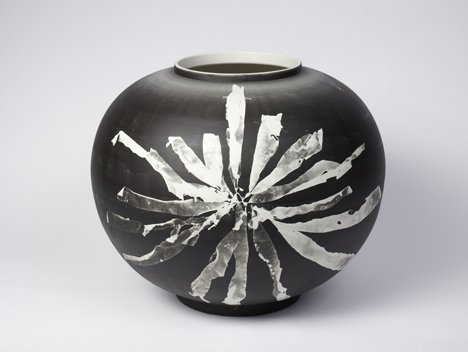
Silverware by Glithero
Reference Link: https://www.dezeen.com/2012/12/02/silverware-vases-by-glithero/
In a similar case to the Blueware Collection, the Silverware vessels have been fascinating to me in their manufacturing process. "Strips of seaweed have left their mark on the photosensitive surfaces of these vases by Anglo-Dutch design duo Glithero." The use of the photosensitive surfaces have been influential in creating the beautiful imagery on the vessel, and creating the shiny and metallic effect that comes through. "The designers applied silver salt particles to the hand-thrown porcelain vases to make their surfaces photosensitive. They then attached seaweed from the English Channel to the vases before exposing them to light, so that the area under the seaweed was protected from exposure. A rotating machine exposed the pieces evenly in the darkroom before they were dunked in developer fluid to complete the process."
MOVEMENT RESEARCH
VouwWow VW01
Designed by: NOORT
Reference Link: https://inhabitat.com/thonets-vouwwow-vw01-is-a-flat-pack-recycled-honeycomb-cardboard-chair/
Dutch studio Nuy of NOORT created this angular chair made from recycled honeycomb cardboard. Specially designed for Thonet label EXT, the ‘VouwWow VWo1’ chair was introduced to the market in 2010 and is sells for less than €100. Light, affordable and recycled, this sustainable seat packs flat to ship and can be set up in a snap without any tools, glue or screws.
‘VouwWow VW01’ is made from a single piece of recyclable honeycomb cardboard and is produced with minimal waste. The design comes in response to the contemporary notion of sustainable materials, efficient transport and easy storage. This foldable chair was awarded the 2009 Thonet Mart Stam Prize for an innovative seat design that adapts to current times without losing the brand’s original concept.
MOVEMENT RESEARCH
Magis Spun Chair
Designed by: Thomas Heatherwick
Reference Link: https://www.nest.co.uk/product/magis-spun-rotating-chair
"Made from a single profile rotated through 360 degrees the aptly named 'Spun' transforms the domestic seat into a beautifully rendered spinning top. When upright Spun is a sculptural vessel and when lent on its side Spun allows its user to swivel in a circular rocking motion, including being able to rotate in a complete circle. The Magis Spun is suitable for indoor and outdoor use."
MOVEMENT RESEARCH
Hanger Chair
Designed by: Philippe Malouin
Reference Link: https://www.dezeen.com/2014/05/20/philippe-malouins-hanger-chair-goes-into-production-with-umbra-shift/
"Folding chairs tend to lie around the house, stacked in a corner, or in an unused room," said Malouin. "When space is an issue, as is the case for most city dwellers, an object such as a folding chair will clutter up the precious available space."
"The Hanger Chair is a folding chair based on one of the ultimate storage systems: the modest hanger. By morphing the function of the hanger with that of the folding chair, a new hybrid is born: a Hanger Chair – that has a function, even when not in use, to store our clothes in an orderly fashion."
MOVEMENT RESEARCH
Zaza Chair
Designed by: Omri Barzeev
Reference Link: https://www.fastcompany.com/90434211/kaiser-permanente-is-reinventing-medical-school-digital-cadavers-and-all
The back of his Zaza chair starts as a single sheet of plastic, which he then covers in felt and folds into shape. The legs of the chair are basically one huge clamp, holding the backrest/seatpan together.
I like how complex the chair looks, even though it''s all folded and created from one piece of plastic. The use of the joints being buttons is also a very innovative and interesting joining technique. It allows for the chair to easily be constructed and put away.
MOVEMENT RESEARCH
Crane the Kinetic Lamp
Designed by Matt Gilbert
Reference Link: https://www.kickstarter.com/projects/animaro/crane-the-kinetic-lamp
DICTIONARY: Tug, Pull, Slide, Push, Reach, Rotate
The lamp can change dramatically in height and shape, its moving form inspired by the shape of the Crane Bird extending its neck to catch prey.
The Crane Lamp is composed of hardwood parts connected by pins. These parts can rotate about each other making the lamp expand and contract.
The lamp can be raised to any position and will always hold its height. This is because the weight of the lamp is balanced against the strength of a spring.
MOVEMENT RESEARCH
Umbrella
Designed by Samuel Fox
From "Collapsibles"
DICTIONARY: Fold, Push, Close
The umbrella is a great example of movement, as its primary function is to open and close on demand to allow people to gain cover from rain. The mechanisms on the handle; pushing the lever, pulling the umbrella up and locking it into place are all part of movement.
MOVEMENT RESEARCH
Moving Landscapes
Designed by Matharoo Associates
Reference Link: https://www.dezeen.com/2016/07/04/sliding-spinning-walls-house-moving-landscapes-matharoo-associates-india-edmund-sumner/
DICTIONARY: Slide, Rotate, Close, Twist
Designed by architects office Matharoo Associates, the house transforms from an "impregnable shell" into a glass pavilion, allowing residents to vary the amount of light, ventilation and privacy in their home.
On some walls, two tiers of panels pivot in alternate directions, while other walls feature panels that slide back and forth.
The motorised systems and supporting structures are all concealed, heightening the effect.
MOVEMENT RESEARCH
Dandelion
Designed by Jennifer Kay and Mary Huang
DICTIONARY: Turning, Rotating, Flipping
A wearable device that captures energy from wind and human movement, turning it into a usable power. The structure consists of miniature windmills that embrace the wearer. It is fashion that creates an interface between nature, technology, and people. When walking or standing outside on a windy day, the windmills turn. Small individual power generating circuits transfer the rotational energy into usable voltage.
MOVEMENT RESEARCH
Drawer
Primary Research
DICTIONARY: Pushing, Pulling
The drawer is able to be pushed in or pulled out with the use of the handle.
MOVEMENT RESEARCH
Lip Balm
Primary Research
DICTIONARY: Twist, Rotate, Pull
The lip balm has many components to allow it to move for the ease of use of a consumer. The lid pulls off. The bottom twists/rotates to allow the stick to go up, and for the stick to be easily carried.
MOVEMENT RESEARCH
Zipper
Primary Research
DICTIONARY: Tug, Pull
The zipper was invented by Whitcomb Judson. It allows for pants to be pulled up, and wallets to be closed securely.
MOVEMENT RESEARCH
Plug
Primary Research
DICTIONARY: Shove, Push
The plug has two main components. The main component is what is pushed/shoved into the socket. The secondary part is the wire, which is push/shoved into the main plug. This is an example of movement and design, as movement is required to push the plug in.
MOVEMENT RESEARCH
Curtain
Primary Research
Dictionary: Pull, Tug
The curtain has the ability to move to allow less or more light in. It moves with the use of the curtain rod and curtain rings.
MOVEMENT RESEARCH
Scissors
Primary Research
DICTIONARY: Cut, Slide
The scissors are able to cut through different materials, as well as can be slidden along a piece of paper to create an easier cut.
MOVEMENT RESEARCH
Salt Shaker
Primary Research
DICTIONARY: Shake, Carry, Flip
The salt is carried in the giant tube made of PET. It can be shaken so that salt can come out of the tube. The lip can also flip upwards to allow the salt to leave the bottle.
EXPERIENCE CITY RESEARCH
Millennials Spend An Average Of 10 Hours A Week On Dating Apps
Written by: Kristine Fellizar
Dating app, Badoo, recently surveyed its database of 370 million users worldwide to discover how much time people really dedicate to dating apps. On average, people spend about 90 minutes a day online dating, and men tend to spend more time swiping on apps than women do (85 minutes versus 79 minutes a day).
It may seem like a lot, but according to the survey, people log on about 10 times a day on average, and each session lasts about nine minutes long. So most people aren't exactly on their phones for an hour and a half straight looking to meet new people. When you're logging on multiple times a day, you never really realize how much time you're actually spending on dating apps. In short, the minutes really do add up. But they might not be necessary.
If you regularly get frustrated or upset by the process, Karyn suggests cutting down your usage down to prevent dating app burnout. "I’ve seen many people make the mistake of spending hours at a time on dating sites, but this can also be counterproductive," Karyn says. "The only thing you need to be successful is consistency and patience."
EXPERIENCE CITY RESEARCH
Minimalist Light Phone
Designed by: Joe Hollier and Kaiwei Tang
Reference Link: https://www.dezeen.com/2017/05/06/minimalist-light-phone-design-used-little-as-possible-mobile-technology/
Designed to be used as a second phone, the Light Phone allows smartphone users to disconnect from their apps while still being contactable via phone call.
"We couldn't help but feel that the last thing we thought the world needed was another app," they said. "There were all of these products and apps coming out left and right all claiming to make our lives better."
"We just couldn't believe any of it anymore – these products didn't respect the user or their time. Being more connected couldn't actually be what we needed to become happier."
This product encourages people to use the phone for the prime function it was created for, calling and communication. No social media and no distractions. Maybe the digital detox should purely focus on eradicating the toxic nature of social media
EXPERIENCE CITY RESEARCH
#artificialselfie
Designed by: Daniel Armengol Altayó
Reference Link: https://www.dezeen.com/2016/04/03/aram-gallery-london-unread-messages-exhibition-digital-communication-addictions/
Uses a moving arm to repeatedly take take selfies and post them to Instagram. It's a commentary on how social media is robotic, and how it lacks emotion.
I like the idea of a product portraying a message. My products so far haven't had any commentary on our social lives or the world; so it'd be quite an interesting development process. If I was able to create a system that had a commentary on how digital devices are taking over our brains, and how we are so engrossed in them we don't notice events occurring in real time, that would be something I think I'd quite enjoy creating.
EXPERIENCE CITY RESEARCH
Block
Designed by: Ernst Koning
Reference Link: https://www.dezeen.com/2019/03/12/block-phone-faraday-cage/
Portable hexagon shaped faraday cage to help us switch off from our phones.
A mesh-wrapped electromagnetic-proof shield – Block is an aluminium case that can store up to seven smartphones, blocking all their connections.
"Just put your phone in it and close the lid. Block will block all incoming and outgoing signals, enabling you to be more present in the moment," said Block designer Ernst Koning, who argues that being offline has become a luxury.
"Two-thirds of the world's population has a smartphone. Moments without rings, pings, pushes and requests for responses have become rare," Koning continued.
"Block gives people a healthier relationship with their smartphones and a chance to reconnect with family and friends, get things done, or just switch off for a moment."
I like the idea of creating a modern solution which is inspired by historic events or pieces, being able to bring back pieces and iterate upon them, or modernise them is something that requires a lot of attention to detail, and needs to be done well for it to succeed.
EXPERIENCE CITY RESEARCH
What Is a Digital Detox?
Reference Link: https://www.verywellmind.com/why-and-how-to-do-a-digital-detox-4771321
WILDLIFE RESEARCH
How To Plant Grass Seeds
Reference Link: https://www.youtube.com/watch?v=cccB1edQpGw
From this video (full video seen in cell block below) I learnt that grass seeds don't need to be planted in any specific way, just onto prepared soil, and then with soil thrown on top of it. This making it the ideal seed to use in the frisbee. It would also encourage people to plant lawns or grass patches in city spaces.
According to turfonline.com "To make a lawn from seed, you need to sow 25-30g of grass seed per square metre. If you are overseeding to renovate an existing lawn or sportsfield, 15-25g/m2 is plenty. If you know the area of the lawn-to-be, you will be able to calculate your seed requirements."
The average grass seed size is also 1mm in length, meaning the holes to allow the seeds to disperse out of the frisbee have to be this size as well.
WILDLIFE RESEARCH
WILDLIFE RESEARCH
Seed Dispenser
Found on Amazon
Looking through what already exists in the realm of seed dispersal is important, so that my idea is not something that's already been invented, and to allow me to analyse the pros and cons of pre-existing solutions.
The seed dispenser uses a lattice structure, which I might try to integrate into the frisbee. Some sort of hole structure that has the ability to let the seeds out in a regulated pattern.
WILDLIFE RESEARCH
Sun Station
Designed by: Julene Aguirre-Bielschowsky
A piece of public furniture that provides free solar energy in open areas. The energy is generated entirely by Mono crystalline solar cells.
The reason I have included this in my research is because it provides free and clean energy as a shared and long lasting solution to the current situation of the world using too many finite materials to fuel cities.
It also encourages people to spend more time outdoors and in public areas, this raising our communication with our neighbours and the environment as well.
WILDLIFE RESEARCH
Bware Water Meter
Designed by: A2 Design Solutions
Gadget that informs the user of water consumption whilst water is being used. The reading is produced by the flow of water passing through an internal generator, which is also responsible for charging the backup battery which keeps the display visible for up to 2 minutes after the water stops flowing.
What I like about this product is it is educating and encouraging a sustainable lifestyle. By informing people of how much water they're using/wasting, which most people are not aware of, or don't know enough about. It's an effective way to raise awareness of water wastage, and helps make saving a precious natural resource more tangible.
I want the product that I create to include this idea of educating others.
WILDLIFE RESEARCH
The Standing Collection: Wanda Chaise Lounge
Designed by: A4Adesign
This is a chair made 100% out of recycled honeycombed cardboard.
What I really love about this product is the idea of biomimicry, and how its curved shape emphasises the irregular texture of the structure of the cardboard, and it creates a strong, sustainable and comfortable product.
WILDLIFE RESEARCH
60BAG
Designed by: Okincyzc Design
A green answer to polypropylene made "green bags". The production of the bag recycles locally harvested plant waste, and turns it into the bag, which is fully biodegradable.
What I like about this bag is that it uses waste materials or byproducts of something and creates a completely functional product from it. I don't think I'd be able to create something like this in the time frame of the project, but the idea of using a byproduct to create such an innovative product is really cool.
WILDLIFE RESEARCH
SeedBomb
Designed by: Konkuk University Industrial Design Students
Normally, when you think of the word "bomb" it brings forward negative thoughts, such as war and death. The `seedBomb aims to change that view, by spreading life and happiness and growth.
What I like about this product is how it uses such a unique way of dispersing seeds, and ensuring that they get planted and grown. The process of it being flown in bulk and released in bulk by air is really interesting. The idea of seed dispersal being done by man. Maybe I could try integrating this into my product.
WILDLIFE RESEARCH
Clay Cups
Primary Research in India
The reason I have included this clay cup in my research is due to the concept of it. This cup has been fired to the point of it being able to hold its shape and liquids, but after it's used it is thrown onto the ground. After which, the cup is thrown on the group and shatters. People gather the pieces every hour and the clay is brought back to its original form with water. It's able to do this because it hasn't been put in the kiln to become a truly kilned piece of clay.
I really like this idea of reusing materials, and not creating any waste with the products, wither in the manufacturing or its use. The material is also biodegradable and doesn't have any negative affect on the planet.
I'd aim to make my product as sustainable as possible, and with this research it has made me realise that the manufacturing of the product is just as important when considering all aspects of sustainability.
WILDLIFE RESEARCH
After Ancient Sunlight - a water-resistant jacket from a plastic made of algae.
Designed by: Charlotte McCurdy
Reference Link: https://www.dezeen.com/2019/11/05/charlotte-mccurdy-bioplastic-raincoat-2/
"New York designer Charlotte McCurdy has fashioned a water-resistant jacket from a plastic made of algae, which captures existing CO2 from the atmosphere."
"All of the threads and fasteners that bring the jacket together are also fossil-carbon-free."
"Crucially, McCurdy explained, unlike a number of other bioplastics, her material is entirely made of algae not just "with some algae"."
Bio-plastics are a new material in the world. I'd quite like using it in my product, or at least attempting to. Plastic is one of the best inventions in our world, as it has become something we can't live without, but also it's the worst thing in our world, as it's the one thing we can't live without.
It's one of the worst materials in the world. It never decomposes, it clogs up the seas, and even kills animals. Finding a sustainable replacement, which is also useful and 100% functional is so important.
WILDLIFE RESEARCH
He and She Dining Chairs
Designed by: Eva Karlou
Reference Link: https://www.dezeen.com/2019/12/05/mater-eva-karlou-stool-chair-design/
"Ethical design brand Mater has launched a chair with a woven rattan seat inspired by Bauhaus founder Walter Groupius."
The fact that this product is both aesthetic and sustainable completely disregards the stereotypical idea that "sustainable products can't be beautiful". I want my product to embody the ideas of minimalism and Bauhaus design theologies, where designs are streamlined and remove all forms of ornamentation. However, it still will look good.
WILDLIFE RESEARCH
Bio-bricks
Designed by: Suzanne Lambert
Reference Link: https://www.dezeen.com/2018/11/06/bio-bricks-human-urine-environmentally-friendly-university-cape-town/
"Lambert used recovered human waste and living bacteria to make the bricks, which can be fabricated in different sizes, shapes and strengths.
She believes the bio-bricks could be a real alternative to traditional bricks, which are heated at temperatures of more than 1,000 degree Celsius, producing huge carbon dioxide emissions."
I'm not saying that I'm not slightly weirded out by this product... I mean it's a brick made of pee! It's so innovative and interesting and eccentric. I can't really believe that it exists.
I would quote like my product to have that same feeling to it. Something innovative, and eccentric. Not something you would ever has heard of.
WILDLIFE RESEARCH
Edible Food Packaging - Scoby
Designed by: Roza Janusz
Reference Link: https://www.dezeen.com/2018/05/21/roza-janusz-creates-sustainable-edible-food-packaging-design/
"Packaging production will no longer litter the environment but enrich it," Janusz told Dezeen.
The idea of creating packaging that prevents littering, is made in a sustainable fashion, and is an enjoyable experience is what drew me to this product.
"Scoby is designed to store dry or semi-dry foods, including seeds, nuts, herbs and salad"
WILDLIFE RESEARCH
Primary Research at Chelsea Physic Garden
WILDLIFE RESEARCH
TASK 3: SOCIETY
In my home life with my parents, we started using less plastic bags and bought our own cloth bags, so as not to keep throwing away bags and polluting the environment even more; and if we did happen to use plastic we would always save it and use it for another day. Not only this, but we have been trying to cut our meat eating to once or twice a week. It is a known fact that mass farming is very harmful to our environment. The production, processing and distribution of meat requires huge outlays of pesticides, fertilizer, fuel, feed and water while releasing greenhouse gases, manure and a range of toxic chemicals into our air and water.
I grew up in Singapore, which is a very green city and is full of trees and clean air. The city has made littering illegal and fines people when they throw trash on the street. Recycling bins are also seen nearly everywhere, instead of trash cans, so it decreases our impact on the environment overall. I don’t feel as if I was negatively impacted by the environment in Singapore, although it is hot and a small city.island, it wasn’t due to environmental issues, it’s because it’s 1 degree north of the equator.
Singapore also holds the undisputed crown as Asia’s Greenest City due to its ambitious environmental targets and its efficient and innovative approach to achieving them.
Singapore's efforts to develop sustainability and eco-friendliness by. integrating nature, harnessing green technology and strengthening. ownership of the land by the people. Sustainability, Singapore style shares how these efforts have. attracted international attention and reaped significant economic benefits.
In terms of my cultural background, I am an Indian citizen. It shames me to say this but India, specifically Calcutta is one of the most unhealthiest and non-environmentally friendly places in the world. As of right now, there is a haze that has labelled the country to have an “unhealthy air quality”. Not only this, but the roads are fun of trash, as people are not very concerned with where trash is placed. The noise pollution is extremely high, as there are constantly honking cars and shouting people. As I said before, I never felt as if I was negatively impacted whilst living in Singapore, however, whenever I visited Calcutta I always fell ill, and never felt really happy whilst there. I would see stray dogs that had been left to wander with legs cut off, or the smog would cause my cousins and I severe headaches. The rubbish and pollution definitely affected the main river, the Ganga. My mother told me that it used to be a beautiful and clear river where people used to pray. Now it’s full of sewage and trash, and people wash themselves inside of it. The worst of it is, the Ganga goes straight out to the sea, and carries all the litter and trash with it.
I don’t think there’s any “traditional” way of living, however, in Asia it is common for children to live with their parents for a long time, even after they’re married. This tradition is heavily implied as most Asian cultures are collectivist, and believe that one persons actions affect the whole families, whilst in the West it tends to be more of an individualistic society.
In India the idea of socialising is called an “adda”, which is basically where people sit or stand anywhere and gossip for hours. It can either be lively or not, it truly is up to the crowd of people who are attending. Indian weddings on the other hand are a major affair, and celebrations can last for a month or even longer. There’s multiple ceremonies and people that have to be invited, some for the grooms side and some for the brides.
These traditions have been passed down from family member to family member.
WILDLIFE RESEARCH
EXAMPLES OF A SUSTAINABLE COMPANY
1. TOMS
Reference Link:
- Does the organisation have the welfare of its members or employees as a consideration?
In 2009, TOMS invested in building a team of international development, health, and nonprofit professionals, now known—appropriately, we think— as the Giving Team. Over the course of 10 years, this team has developed relationships with over 200 non-governmental and humanitarian organizations in 80 countries worldwide. We call these organizations our Giving Partners, and they are critical to the way that we give. Working hand-in-hand with these organizations, we’re able to better understand the needs of the communities they serve. Additionally, we can help meet these needs by integrating TOMS resources into their existing programs.
- Does the organisation contribute somehow to the country or region where it is based?
The company has helped the poor and impoverished from all over the globe
-
Does the organisation maintain the crafts or production techniques specific to that area?
- Does the organisation consider the working conditions of its employees?
Yes 100%
- Can economic growth be compatible with sustainability?
I believe it can be compatible.
Sustainable systems are often created since it is a more complicated process (e.g. completely cutting down trees in a forest vs cutting down specific trees and replanting and nurturing). Jobs can be created in terms of resource management and growth of the company.
Personal income will increase due to companies being more productive and raising more profits. As a result, job growth will also increase.
Not only this, but in our modern world a "sustainable" company is viewed highly by the public, and many people will flock towards it to support it.
- What can art and design organisations / companies do to foster sustainability?
I think that companies really need to take into account the environmental impact of the products they're making, all the way from the cradle to the grave. When saying this, I mean that the entirety of how the product has been made (from the growth or finding of the materials) to the end of its life (disposing of it), the company should take into account how much energy it required to go through each stage. However, if a product could be made to be recycled, that would be even better.
- Can companies make a profit without compromising their measures to foster sustainability?
I guess it depends on what the company achieves to make? I believe that in our world now it can be done, although a lot of work has to be put into it. However, at first it might be a rocky start. This could be due to buying new machinery or materials that in the long term would increase economic growth and environmental friendliness, but in the short term might affect the companies economic growth in a negative manner,
UTILITY RESEARCH
3D Soundscape Headset
Designed by: Microsoft and Future Cities Catapult
Reference Link: https://www.dezeen.com/2014/11/06/future-cities-catapult-microsoft-guide-dogs-3d-headset-soundscape-to-help-blind-people/
"Using audio technology developed by Microsoft, orientation, navigation and contextual information is delivered through vibrations in the headset that transmit sound through the wearer's jaw and cheek bones to the inner ear, bypassing the ear drum.
This, combined with bone's ability to conduct lower frequency sounds more efficiently than air, allows the wearer to still hear the noises around them as usual, but also be aware of another layer of voices and alerts from the device.
The locations of coffee shops, ticket gates and points of interest, as well as directions, can be spoken to the wearer by the device to help them better understand where they are."
Makes me think of how this adjustable headset could be incorporated into a utility, or solve an issue. AI.... not enough time for a one week project, but how about an airpod which could connect to your body/system and be able to alert you about certain things u=during the day, or if you had appointments?
UTILITY RESEARCH
Tatik
Designed by: Tembolat Gugkaev
Book:
Incorporating an arm chair and a shelving unit in one serves to approach furniture design from a different angle. Literally slanting to create a pyramidal form, the 'Tatik' does well to keep all of your books and possessions tucked away and secure.
It provides adequate storage and allows a person to stay comfy in their chair and grab a book with ease.
UTILITY RESEARCH
Primary Research at SPC Furniture Store
Bedside Table in Scrapwood by Piet Hein Eek
Meticulously crafted in Piet Hein Eek's studio using traditional woodworking techniques and bis quintessential vocabulary of recycled wood collage. Each piece is available with a fixated or characteristic high gold finish. Due to the nature of the material used in production, each piece is a one of a kind. Made in the Netherlands.
I was enchanted by the use of the traditional woodworking techniques, as well as the idea that each bedside table is unique, and created out of scrap wood materials.
UTILITY RESEARCH
Primary Research at SPC Furniture Store
Kaarl Wall Hook by Artek
A simple elegant take on the coat hook. The hook unites two materials - oak and steel - the hook makes a distinctive and practical addition to public or private spaces.
I like the simplicity pf this product, and how it has removed all the frills or unnecessary adorations that many products do like to utilise.
UTILITY RESEARCH
Primary Research at SPC Furniture Store
Ernö Hook by Michael Marriott
I like this design as it's simple and effective in what it wants to achieve. The design was also designed in honour of the architect Ernö Goldfinger. It's simple and minimalist, and can be an inspiration for the idea of a phone holder, that can also charge a phone.
UTILITY RESEARCH
Primary Research at SPC Furniture Store
Multilite Pendant by Louis Weisdorf
The Multilite features two cylindrical shapes and two quarter spherical shades within a metal ring. The lamp reflects Welsdorf's passion for diversity, allowing the user to adjust the shades in both functional and aesthetic combinations.
I really liked the style of this lamp, and its unconventional design in how it allows light to be seen. I also like the simplicity and almost Bauhaus inspired aesthetic of it.
UTILITY RESEARCH
Primary Research at SPC Furniture Store
Abstract Assembly by Donna Wilson
I found the backing of this chair to be really intriguing. It looks like the pieces of wood have been knitted together, or attached with the use of those wood pieces. The shapes of the pieces also don't match up, and create this weird pattern that has holes in the middle of the chair. I like this Memphis-inspired, funky aesthetic.
UTILITY RESEARCH
Primary Research at SPC Furniture Store
Bonbon Pendant Light by Ana Kras
I really love the handwoven aspect of this lamp. The soft wool shades gently defuse lightened produce a warm and soft glow. The colours meld together beautifully, and the use of the strings intertwining between each other allows for the lamp to look family friendly.
VESSELS RESEARCH
The Dipr
Designed By: Robert Hauleluk
This is a cookie dunker made specifically for Oreo cookies. It's created for kids. I decided to include it in my research as I like the simplicity of the product, and how it has been manufactured for one specific shape and size.
Reference Link: https://www.kickstarter.com/projects/rhaleluk/the-dipr-a-spoon-for-dunking-sandwich-cookies
VESSELS RESEARCH
"When you dunk a chocolate chip cookie, you change everything about it: the texture, the flavor, right down to the chemical composition. As Matthew Harting, a chemistry professor at American University, explained to Quartz, the secret is a group of chemical additives called emulsifiers."
"Both chocolate and milk contain emulsifiers. The ones in chocolate let fatty ingredients (oil and cocoa butter) mix with ingredients without fat (water and cocoa powder). They also keep the fat in milk from collecting at the top of your glass."
"This delicious magic, aka science, is taken to the next level when chocolate chip cookies are dunked in milk because the emulsifiers from both substances interact on your tongue. Milk calms down the intense sweetness from the chocolate, Harting said, and emulsifiers “help to smooth out the chocolate as you’re eating it,” giving you the perfect creaminess-to-cookie flavor ratio. Otherwise, it could taste too gritty and crunchy."
VESSELS RESEARCH
Body Buddies by BNAG
Reference Link: https://www.dezeen.com/2019/02/11/bnag-body-buddies-ceramics-nomad-design/
"German design studio BNAG encourages us to celebrate our flaws with a collection of lumpy nose vases and pink nipple clocks."
"Each piece boasts the natural irregularities that come from the process of hand-crafting, encouraging people to in turn embrace their own flaws."
"Some of the ceramics are bumpy and rugged, some are cracked, because we all have scars and things that we wish were different, but it's all about embracing and celebrating those parts of your body, and putting them on display in a domestic environment."
VESSELS RESEARCH
The Pan Whistling Jug
Designed by: Pierre Charrié
Reference Link: https://www.dezeen.com/2018/09/24/pan-whistling-jug-pierre-charrie-product-design/
"The ceramic Pan whistling carafe is a reinterpretation of pre-Columbian ceramic vessels found in Peru. These were used as ceremonial tools to produce sounds for healing purposes or to invoke spirits."
"As the water moves around inside the jug it creates a movement of air that passes through a whistle built into the hollow of the handle."
"The jug takes on the shape of a bird, a zoomorphic design that nods to the original Peruvian vessels. The streaked texture adds animality to the volume, referencing the bird's feathering as well as the water movement in the jugs."
I decided to include this product into my research as I enjoy the playfulness of the product. As well as how it is able to encapsulate Peruvian culture and history. Not only is the vessel inspired by history, but a sense of biomimicry can be found within it.
The technological aspect of being able make a ceramic vessel produce noise is also extremely interesting, and seems very complex.
VESSELS RESEARCH
Magnetism Meets Architecture by Jolan van der Wiel
Reference Link: https://www.dezeen.com/2014/07/06/jolan-van-der-wiel-magnetism-meets-architecture-ceramics/
"van der Wiel created a series of ceramic objects using a process that exploits the conflicting properties of natural materials and processes."
"Gaudi's small model of La Sagrada Familia was quite inspiring for this project," Van der Wiel told Dezeen. "He used gravity to calculate the final shape of the building. I thought, 'What if he had to power the turn off the gravitational field for a while?' Then he could have made the building straight up."
The use of the science behind this vessel is truly jaw dropping. Creating a vessel using magnetic fields, and clay to create the product is totally revolutionary.
VESSELS RESEARCH
Kintsugi Pottery
Reference Link: https://www.invaluable.com/blog/kintsugi/
This form of pottery doesn't look at the creation aspect of one vessel, but instead how a vessel has been "destroyed" and put back together. In this sense, the Japanese believe that the cracks are the true beauty behind the product, rather than the product itself, which is why they're painted in gold, as to highlight their elegance.
"Kintsugi is a centuries-old Japanese art of repairing broken pottery and transforming it into a new work of art with gold, the traditional metal used in Kintsugi."
VESSELS RESEARCH
Set Of Three Petrol Blue Ombre Vases by Andrew Wicks
Reference Link: https://www.andrewwicks.co.uk/new-gallery/
The use of colour in these beautiful piece is what has led me to include it in my research. I'm interested in how the painting was added so smoothly, as well as on the textured ridges.
VESSELS RESEARCH
Grogged Vessels by Sevak Zargarian
Reference Link: https://www.sevakzargarian.com/grogged-vessels
I really enjoy the use of bowl being so grotesque in nature with the use of the sticking out pieces of ceramics. The colours used also add to the minimalist affect of Zargarians work, but the layering of the ceramics is such an ironic and huge contrast.
"This collection of grogged porcelain vessels explores the liminal space between craft and design by using craft elements with industrial techniques creating process-driven tactile surfaces within decorative objects. Grog, fired ceramic pieces, is the craft element which is paired with reverse casting to control the inside shape of the vessels, but leaves the rest to be influenced by the process. This results in the random pattern of the grog throughout the body of the vessels."
VESSELS RESEARCH
Trapunto by Quintessence
Reference Link: http://www.guillaumedelvigne.com/trapunto-quintessence/
The reason I've included this product in my research is due to the interesting shape of it, as well as the fact that it's a lamp. It's extremely interesting how a light is able to fit inside the hole of the lamp, and how the clay has been carved to create this bulbousy shape to accommodate a bulb.
VESSELS RESEARCH
Facet Bottle and Diamond Vase by Hella Jongerius
Reference Link: http://www.jongeriuslab.com/work/Facet-Bottle-and-Diamond-Vase
The vase has been made from porcelain and is so beautiful with its expressive colouring. "The facetted bottoms of the large porcelain Facet Bottle and Diamond vase still refer to this folding technique. The facetted surfaces break the light, and the colour, in parts, allowing to better see how a colour changes depending on the location it has on the object: in the light or shadow, on a hollow or convex part. The facetted surface is combined with a textured pattern that is meticulously carved out of the porcelain by hand."
The colouring has been done by "layers of matte and shiny glaze overlapping each other, creating layered colours."
The work behind this minimalist and attractive vase is truly mind-blowing, which is why I have it included it in my research.
VESSELS RESEARCH
Strangles Lights by Gitta Gschwendtner
Reference Link: http://www.gittagschwendtner.com/object_frameset.html
The fun and somewhat morbid representation of these lights is what really draws me to it. I love the way the bottles look as if they've been tied up, and it makes me think about how the clay was cast and layered over the mould.
VESSELS RESEARCH
Crystallization 78 by Lukas Wegwerth
Reference Link: https://www.dezeen.com/2016/04/02/gallery-fumi-pad-paris-fair-new-design-study-o-portable-thomas-lemut/
The complexity behind the creation of this vessel really speaks to me. As well as the brutal beauty in its aesthetic. The vase has been "made from broken pieces that have been put back together by growing white and pink salt crystals around them." I really enjoy the way the salt crystals have been intergrated and meld with the vase.
VESSELS RESEARCH
Fuzz Side Table by Study O Portable
Reference Link: https://www.dezeen.com/2016/04/02/gallery-fumi-pad-paris-fair-new-design-study-o-portable-thomas-lemut/
The reason I've included this in my research is due to how the vessel was made. "The furniture has been created using layers of a gypsum-resin composite called Jesmonite, which is then cut across the middle to form a tabletop and reveal the central circular pattern." This allows the table to resemble tree bark and its circular rings. The material is also an interesting choice, as these tables could actually be made from wood, but instead, is made from this substance Jesmonite. I also enjoy the simplicity of the product and its minimalist aesthetic. However, I'm unsure of why the hole has been cut into the middle of the table.
MOVEMENT RESEARCH
Flexi-Chair
Reference Link: http://www.flexiblelove.com/
This is a chair made 100% of paper that can bend and fold into different shapes and has the ability to accommodate more people to sit on it. I like the fact that it's made out of an unconventional material, since paper is quite a weak material.
MOVEMENT RESEARCH
Comodo Crutch
Designed by: Denise Kim Wy
Reference Link: https://gajitz.com/take-a-seat-transforming-crutch-lets-you-rest-wherever/
The Comodo Crutch is a chair that can both aid in movement and be moved. It's a very popular product in the market due to how simple it is in style as well as weight, which isn’t very much. The chair that is on the product itself has a very innovative and aesthetically pleasing outlook, as it doesn’t disrupt walking or grip on the bars, but also doesn’t show all the mechanics that has gone behind it, since users now want a ‘minimalistic’ and ‘simple’ point of view. There only seem to be a few issues which consumers feel should be addressed, the ease of use for the product isn’t very easy as it involves a lot of movement and ending down to adjust the chair, the product is quite expensive since it’s made in such a small batch due to its many original features, as well as its manufacturing style, which is apparently a very tedious process, and the last issue which is that it’s for only one type of crutch, not for the elbow crutches, which some people use as well, and there aren’t any products out there for them.
MOVEMENT RESEARCH
Chair/Chair
Designed by: Eric Ku
Reference Link:https://www.fastcompany.com/90434211/kaiser-permanente-is-reinventing-medical-school-digital-cadavers-and-all
This chair is a fun and friendly version of flat pack furniture. The reason I have included it in my research is how the pieces that spell out "CHAIR". There are no additional joints (such as screws, nuts and bots, etc) but rather the pieces have been cut so they fit like a jigsaw.
MOVEMENT RESEARCH
La-Z-Boy
Designed by Edward Knabusch
DICTIONARY: Push, Pull, Twist, Fold, Drop, Reach
The La-Z-Boy chair is a great example of movement within a design, as well as kinetic design. The whole purpose of the chair is to create a comfortable seating position for a user to sleep in after a long day, to catch a quick nap. The lever next to the chair allows for the backing to be pushed down, and the footrest to come up, by being pulled with the use of the lever. The La-Z-Boy also incorporates dropping, folding and twisting, within its complex mechanisms.
MOVEMENT RESEARCH
Explosion Cabinet
Designed by Sebastian Errazruiz
Reference Link: https://www.gessato.com/wooden-cabinet-explodes-into-unique-kinetic-design/
DICTIONARY: Tug, Pull, Carry
A kinetic design that plays with a classic technique, the sliding dovetail, and expands it into new territory. The imaginative sideboard features natural wood and glass, simple materials which let the shape take the spotlight. The furnishing appears normal in its neutral, closed position and out-of-this-world when the wooden rails are pulled to the end of their reach.
MOVEMENT RESEARCH
ATE
Designed by Paul Sandip
DICTIONARY: Turn, Roll, Cut
ATE is what remains of the excess material of the pencil sharpener is removed; that is, two opposite cones, joined together at their narrowest end containing a blade.
MOVEMENT RESEARCH
Solstice, The Kinetic Clock
Designed by Animaro Design
Reference Link: https://www.designcommunication.net/design/best-examples-of-kinetic-design
DICTIONARY: Rotate, Twist, Fold, Turn
It is a moving clock that changes its flower-like frame throughout the day when the sun is higher in the sky (midday) the clockface is at its biggest. In the evening (6 pm) the clock is at its smallest. This clock gracefully expands and contracts with each passing hour of the day. Thanks to the specific structure it shows the time from the shape of the clock face, not only with the position of the hands.
MOVEMENT RESEARCH
The Expanding Table
Designer: Unknown
DICTIONARY: Pull, Rotate
The table has the ability to expand, and accommodate for more people to sit around it. Often times the mechanism is either done with a lever, or a knob, which the user can pull or rotate to allow for the table to grow out in size; the same can be done when the table has to "shrink".
MOVEMENT RESEARCH
Quadrant House
Designed by Robert Konieczny
Reference Link: https://www.dezeen.com/2019/05/21/quadrant-house-robert-koniecznys-moving-terrance/
DICTIONARY: Turning, Rotating, Pushing
Quadrant House is named after the device used by astronomers to determine the position of the stars. This motif forms the basis for the concept of the building's moving section, which pivots through 90 degrees.
"Part of the building reacts to the sun and follows its movement," Konieczny told Dezeen.
"It gives residents shade and pleasant airflow when they are there, but also control of the sunlight in the building or extension of its space."
MOVEMENT RESEARCH
Folding Designs
From "Collapsibles"
DICTIONARY: Fold
MOVEMENT RESEARCH
Jelloware
Designed by The Way We See The World
From "Green Design"
DICTIONARY: Carry
A line of edible cups in different flavours that compliment a corresponding drink. The cups are made from agar agar, and can be nibbled on whilst drinking; leftovers can be put into composting. It is translucent, moldable, edible and biodegradable.
MOVEMENT RESEARCH
Switch
Primary Research
DICTIONARY: Flip, Press
The switch flips and presses to allow for lights to be turned on. The use of the responsive design also ensures and comforts the user that the mechanism is working.
MOVEMENT RESEARCH
Automated Door Lock
Primary Research
DICTIONARY: Tap
The tapping mechanism of the key to the lock allows for the contents of the room to be kept safely.
MOVEMENT RESEARCH
Lamp
Primary Research
DICTIONARY: Slide, Close
The lamp has a covering that can slide over it and shut off the light that comes out from the lamp. The lamp is used for religious purposes for people who can’t switch off lights due to religious reasons.
MOVEMENT RESEARCH
Sunglasses
Primary Research
DICTIONARY: Folding
The sunglasses have the ability to fold, as seen on the sides of the frame; with the use of hinges. Allowing for them to be easily carried around either in a case, or a pocket.